How to Calculate Wallpaper Rolls for Pattern Repeats (UK Room Sizes)
The label on the roll says it covers about five square metres. On a plain paper that figure is close enough. Add a 64cm repeat and a straight match, though, and the same roll might realistically cover three. Most wallpaper miscounts come down to the repeat rather than the arithmetic — and it is a miserable feeling to run out two drops from the end of a wall.
Here is the whole method, start to finish, using the roll sizes and room dimensions you will actually find in a UK house.
Know exactly what is on the roll
Most British wallpaper comes as a 10.05m roll, 53cm wide. Budget ranges and some imported papers are 10m by 52cm, and wide-width papers run to 70cm or even 1.06m. Both numbers matter, so read the label rather than assuming.
On that same label you will find the pattern repeat, given as a measurement in centimetres, and the match type. Write both down before you do anything else. Then ignore the "covers approximately 5 sq m" line for any patterned paper — it assumes no waste whatsoever, and with a large repeat you can lose a quarter of every roll to matching.
Measure the room properly
Start with height. Take the floor-to-ceiling measurement in at least three places — a corner, the middle of the wall, and above a radiator — and use the tallest. A slightly bowed ceiling or a thick bit of skirting can easily change things by 3cm or 4cm, and that difference decides how many drops you get from a roll.
Then measure each wall individually. Take the width near the ceiling and again near the skirting and use the larger figure. A single perimeter measurement is fine for a rough estimate, but rooms are rarely truly square, and an alcove or a chimney breast changes the drop count entirely.
Before you calculate, note down:
- The tallest floor-to-ceiling measurement
- The width of every wall or papered section
- Doors and windows, with their widths
- Anything you are papering around rather than over — radiators, pipe boxing, a fireplace surround
- The pattern repeat and match type from the roll label
Add 5cm top and bottom to your height for trimming. If the ceiling slopes or the walls are old and uneven, allow 10cm at the top instead.
Should you deduct for doors and windows? Many people do, and it feels satisfying. I would leave them in. The two metres or so that a door and window occupy is your insurance against a mis-cut drop or a corner that will not quite line up — and with a large repeat you will lose that much to matching anyway.
Read the repeat and the match type
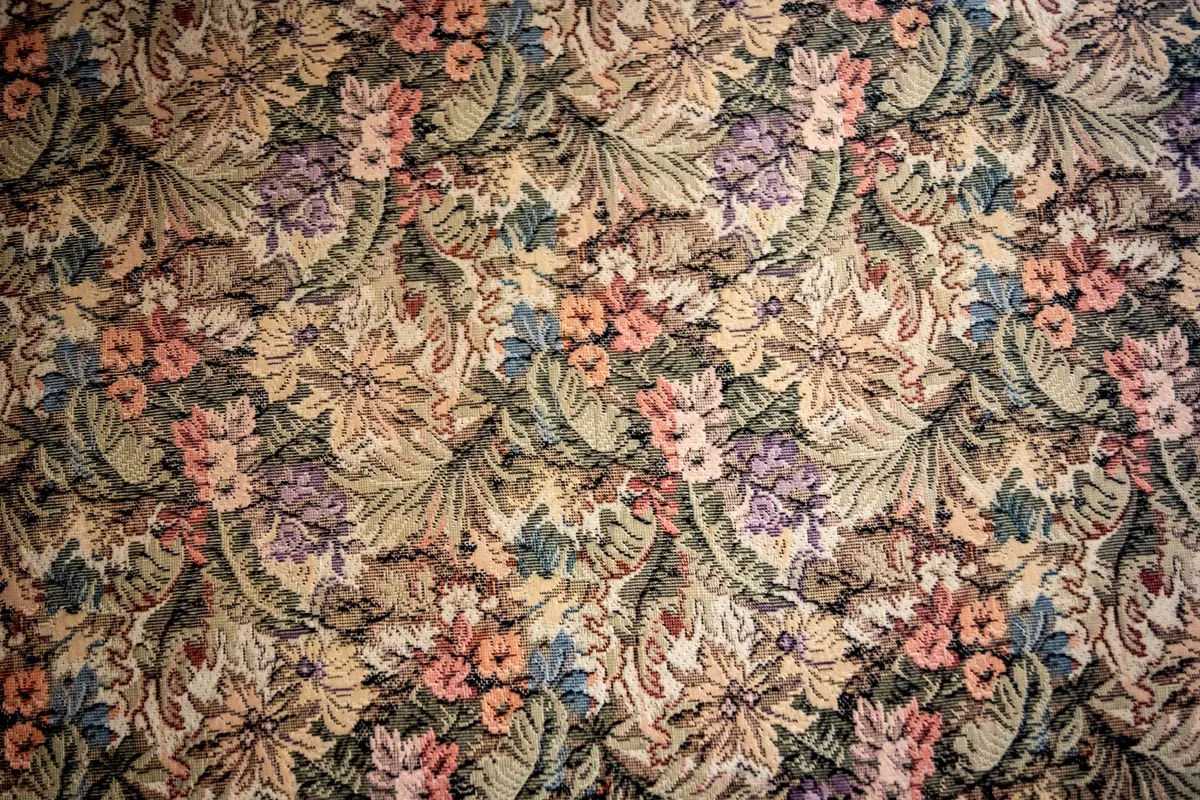
The pattern repeat is the vertical distance before the design starts again. A tight 20-30cm repeat costs you almost nothing. A trailing floral or a damask can repeat at 64cm, 90cm or more, and that is where rolls disappear.
Straight match
Every drop lines up with the one beside it at the same height. This is the simplest to work out: each drop must be a whole number of repeats long, so you round your cut length up.
Offset or half-drop match
Alternate drops are shifted down by half a repeat, so the pattern staggers across the wall. The drop-length sum works out much the same, but the offcuts are less useful because they only fit in one direction. Allow roughly 10 per cent extra on your final roll count.
Free or random match
No matching at all — you simply butt the edges together. Your drop length is the wall height plus the trim allowance, with nothing rounded up. Rare, but worth checking for.
Work out drops per roll
Take your tallest wall height and add the trim allowance. On a 2.4m ceiling that gives you 2.5m. With a 64cm repeat, divide 2.5 by 0.64 to get 3.9. Round up to 4, then multiply back: 4 x 0.64 = 2.56m per drop.
Now divide the roll length by that drop length. 10.05m divided by 2.56m is 3.9, so you get three full drops from a roll. The 2.37m left over is not enough for a fourth, and no amount of wishing will change that.
Plain and free-match papers are easier: 10.05m divided by 2.5m gives four drops per roll, with a little spare.
A worked example: 4.2m by 3.6m room
A typical double bedroom, 2.4m ceiling, 10.05m x 53cm roll, 64cm straight repeat.
The perimeter is 15.6m. Each drop is 2.56m and each roll gives three drops.
- 4.2m wall: 4.2 divided by 0.53 is 7.9, so 8 drops. Two of these walls: 16 drops
- 3.6m wall: 3.6 divided by 0.53 is 6.8, so 7 drops. Two of these walls: 14 drops
- Total: 30 drops
Thirty drops at three per roll gives ten rolls.
Compare that with the label's own arithmetic: 15.6m x 2.4m is 37.4 sq m, divided by five is 7.5, so eight rolls. The repeat and matching have added two rolls — a quarter more paper. If you do deduct the door and window, you land on nine rolls, which is why that tenth roll is worth keeping as a spare rather than returning.
Adjustments and things people forget
- Batch or dye lot numbers. Every roll in a job should carry the same one. Two batches of the same design can differ enough to show along a seam.
- Wide-width paper. A 1.06m roll covers fewer drops per roll but each drop is twice as wide, so redo the sum rather than scaling it.
- Feature walls and ceilings. Run the calculation per surface using its own width and height. A ceiling needs its own dimensions entirely.
- Radiators and boxing. Paper behind a radiator and around pipe boxing — it is visible from an angle, and future owners will notice.
- Returns. Many retailers will not accept opened or pasted rolls, so get the number right before you start cutting.
Before you place the order
Round up rather than down, every time. Add one spare roll for future repairs — a scrap of the same batch is the only thing that will ever match a scraped wall at the bottom of the stairs. Store it flat, away from damp, and photograph the label with the batch number in case you need more later.
If the maths is making your eyes cross, give the retailer your wall height, your total width and the repeat from the label. Most independent wallpaper shops will check your figures in a couple of minutes, and they would far rather sell you the right ten rolls than have you come back for one more when the batch has sold out.
Photo: 3844328 / Pixabay