

British Botanical Motifs: A Short History of Floral Patterns in UK Textiles
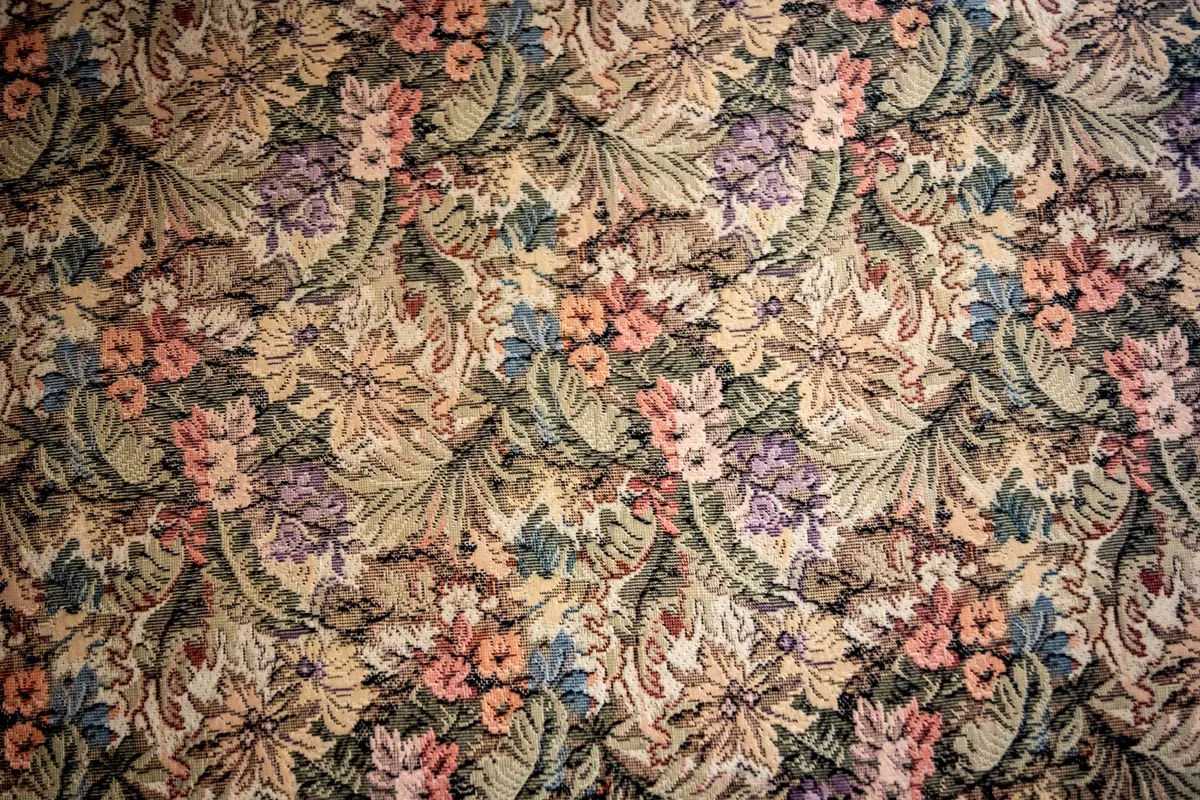
Look closely at a length of printed cotton in a British kitchen and you are usually looking at a hedge. Not the whole hedge — a chosen handful of it: a hawthorn sprig, a dog rose, a strand of honeysuckle twisted into a tidy loop. British botanical pattern grew out of close observation of a fairly modest flora, and that modesty shaped everything about it: fine drawing, small motifs, restrained colour and repeats built to be lived with rather than admired from across a room.
The hedge as a sourcebook
Britain's wildflowers are small. Set beside the flamboyant blooms that fill Indian and Ottoman textiles, a bluebell or a wood anemone offers very little mass, so pattern designers here learned to work with structure instead: the curve of a stem, the shape of a leaf, the way a seed head sits on the stalk. Tudor embroiderers worked detached "slips" — a single flower or insect stitched on its own and then applied to a garment — and the plants they chose were overwhelmingly local. Honeysuckle, borage, strawberries, oak leaves with acorns, peas in a pod, wild roses and columbines all appear on coifs, sweet bags and cushion covers.
Printed pattern books, mostly imported from Germany and Italy, supplied woodcut versions of the same plants, which is why early English work often mixes a sharp-eyed native flower with a pomegranate or an iris lifted from a continental source. The habit stuck. British floral design has always been a conversation between what grows at the end of the lane and what arrives in a pattern book.
Chintz, calico and the making of the fine repeat
Painted and printed cottons from India reached Britain in the seventeenth century and caused a fuss: wool and silk weavers lobbied against them, and there were periods when imported cottons were restricted. The practical response was to make them here. Lancashire printers learned to reproduce the Indian look — trailing stems, fine outlines, a handful of fast colours — and then improved the machinery behind it. Copperplate printing, from the middle of the eighteenth century, allowed a far finer line than a carved wooden block. Roller printing, later in the same century, allowed a repeat to run continuously down metres of cloth.
That technical shift explains the character of a classic British floral: delicate drawing, a long repeat, and colour sitting flat inside a printed outline. By the nineteenth century, William Morris was drawing from life in the garden and along the riverbank — marigolds, willow boughs, acanthus, honeysuckle — and having his repeats cut as blocks, dyed with indigo, madder and weld. Liberty built its reputation on smaller, close-set florals in softer colourways, printed on lightweight cotton and lawn. Different workshops, same instinct: take the plant, keep the line, lose the shading.
A working lexicon of British plant motifs
Most British botanical prints are built from a surprisingly short cast list. Knowing what each plant tends to signal is useful whether you are dating a textile, choosing one, or drawing your own.
- Rose — both the heraldic Tudor rose and the wild dog rose. Open, layered, endlessly repeatable.
- Thistle — Scottish and heraldic; a spiky silhouette that prints well in a single colour.
- Shamrock and clover — Ireland; the three-lobed leaf makes a natural triplet repeat.
- Daffodil and leek — Wales; the daffodil gives a bright trumpet, the leek an upright blade.
- Hawthorn — May blossom, tied to spring and weddings, often shown alongside blackthorn and stitchwort.
- Honeysuckle — the twisting stem Morris loved; excellent for trails and stripes.
- Foxglove — a tall spire, ideal for giving a border vertical rhythm.
- Bluebell — hard to print literally as a blue haze, so usually simplified into a bell on a bending stem.
- Oak, acorn and ivy — medieval favourites, solid enough for borders and corners.
- Cornflower, poppy and lavender — field and garden flowers that supply the cooler blues and soft greys in a colourway.
Mixed in among these you will also find the paisley cone, a plant-derived Persian form that arrived through shawls woven in Paisley and printed in the same mills as florals, and which now reads as thoroughly British.
How a botanical repeat is built
Almost every botanical pattern on cloth is one of four structures. If you are designing your own, choose one deliberately rather than by accident.
- Sprig or spot repeat. One small motif on a grid. Easiest to draw and hardest to make interesting — vary the angle and the size slightly.
- Half-drop. The motif steps down by half its height each time it repeats across. This breaks the rigid grid and gives a printed floral its gentle drift.
- Mirror or diamond. The motif is flipped horizontally or vertically so it meets itself. Good for a large open flower that needs company.
- Trail or meander. A stem wanders across the cloth with flowers hung on it. This is the structure behind most Arts and Crafts florals and nearly all curtaining.
Two habits that save hours
First, work with paper. Draw the motif, cut it into quarters, rearrange and tape it back together, and you will see immediately where the repeats collide. Software does this neatly, but scissors teach it faster.
Second, test the tile at three sizes — roughly 15 cm, 5 cm and 2 cm — and look at each from two metres away. Small motifs read as texture, large ones as illustration, and the middle ground is where most designs go wrong.
Regional strands: thistle, leek, shamrock and paisley
Regional identity sits lightly on British pattern, but it is there. Scotland contributed the thistle and the paisley shawl trade, and the dense multi-colour thinking of tartan sett a habit of designing in grids. Wales has its own tradition of tapestry and doublecloth, where small repeating botanical forms sit inside geometric borders. Irish linen carried the shamrock and the rose, often as white-on-white damask, where the motif is read in the weave rather than in colour.
The strongest thread, though, is not regional at all. It is the cottage garden: a mixed, slightly disorderly bed of whatever grows well, printed all together. That is why British florals so rarely show a single species in isolation. They show the whole border, weeds and all.
Putting botanical motifs to work
If you are choosing fabric rather than drawing it, scale is the decision that matters most. A generous motif can carry a cushion or a curtain panel; a tight repeat suits a lampshade, because a shade curves and a large motif will distort around it. Always buy at least half a metre extra for pattern matching on curtains, and check whether the repeat is a straight match or a half-drop before you cut.
Colourways change behaviour more than pattern does. The same print in two colours looks graphic and calm; in five it becomes busy and needs a plainer room around it. If you are unsure, buy a sample and pin it up for a few days in the light where it will actually live, since printed florals shift considerably between daylight and lamplight.
For designers, the sequence that works is simple: draw from life in pencil, reduce the drawing to a flat silhouette at about 2 cm, and see whether it still reads. If it does, it will print. Then tile it, test it, and print a metre of real cloth rather than trusting a screen. Keep a swatch book and note the printer, the method and the repeat size beside each sample — you will want that information again far sooner than you expect.
Next time you pass a hawthorn hedge in May, look at how the blossom sits on the stem. The repeat is already solved.
Photo: Magda Ehlers / Pexels